Zak Greant’s OSI Weekly Report 2008 Week 11
This report is a summary of Zak Greant‘s Open Source Initiative activities for the week of March 16th to 22nd, 2008. This Week Alolita, Andrew and I worked on the…
This report is a summary of Zak Greant‘s Open Source Initiative activities for the week of March 16th to 22nd, 2008. This Week Alolita, Andrew and I worked on the…
This report is a summary of Zak Greant‘s Open Source Initiative activities for the week of March 9th to 15th, 2008.
This Week
This was my first week of real activity in 2008 (except for my attendance of the March 2008 OSI face-to-face meeting.)
I wanted to give a quick shout out to our President, who was just listed as one of eWeek’s Top Ten Open-Source Business Influencers. Wish they could’ve gotten a better…
An Information Week article published last week appears to position Microsoft as trying to do something right when it comes to open source. And it positions the open source community…
Are you a patent holder, wondering how to write software which implements your patent? Here’s my advice: Patents expire. Towards the end of the patent’s lifetime, you want to be…
March 26 is Document Freedom Day (DFD). On March 26th, events and activities across the world will be held to promote adoption of free document formats such as the Open…
This is the text of a comment I made on a blog posting by Matt Asay: Matt, Thanks for saying what I would have said. I’ll go a few steps…
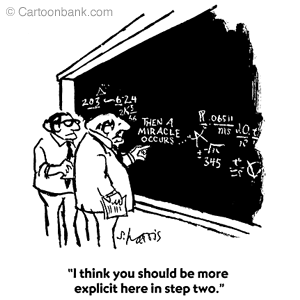
OOXML needs to die. It’s clear that OOXML is a faux standard — not because it’s a vendor standard. There are lots of vendor-created standards which are real standards (e.g. PostScript). No, OOXML is a botch because it’s expressed in terms of an undocumented Microsoft graphics library. OOXML is all “and then a miracle occurs”. You’ve seen that cartoon, right?
Steve Ballmer asks, in an E*Week interview, who speaks for the Open Source Community, and answers his question by saying that nobody does. True enough! He then goes on to point out that Larry Ellison, he speaks for Oracle, yes. True enough! But who speaks for the proprietary software vendors? When we, the open source community, want to make an agreement with the proprietary software vendors, who do we talk to? Do we talk to Larry? Or Steve? Or Jonathan? Or Curley? Or Moe?
Simon, I’m beginning to think that you were right and I was wrong. You said a standard’s process is a crucial aspect of the standard’s product, and a process that…
The OSI adopted a mandate of working on Open Standards two years ago. We put forward a statement on requirements for an Open Standard which boiled down to a simple…
One of the high points of my last trip to California was meeting James Burgett. Burgett is an utterly fearless man, a former drug addict who candidly admits he originally began recycling and assembling computers to finance his habit but then got clean and founded one of the most effective and remarkable nonprofits I know of.
We’ll never share your details and you can unsubscribe with a click!